At a glance
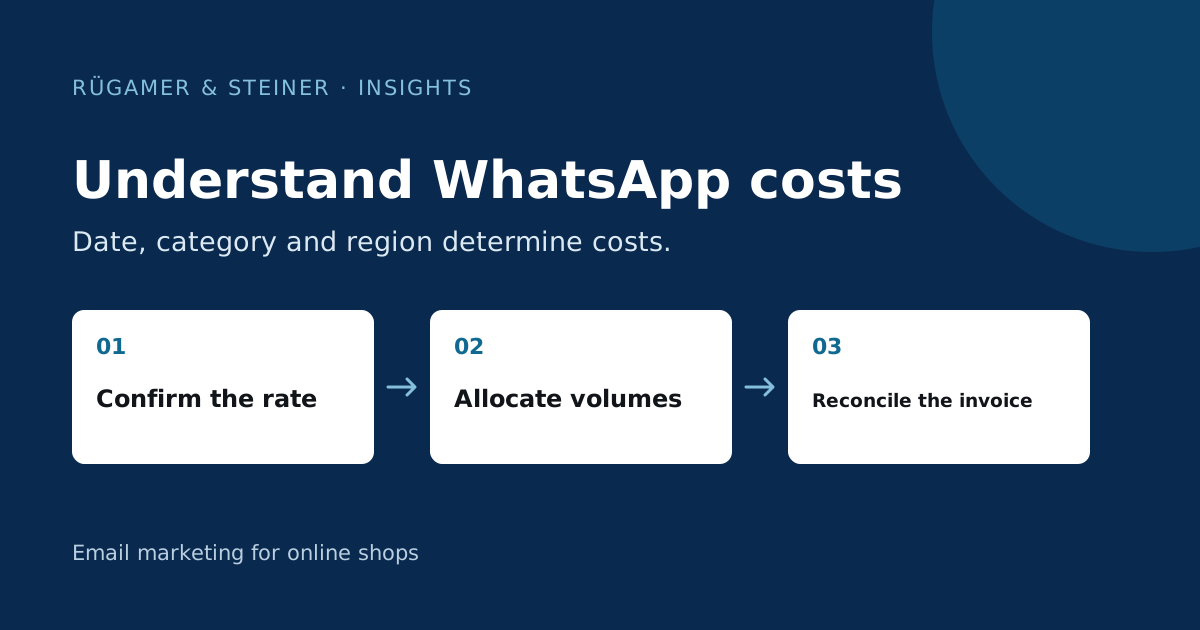
Calculate basic costs, messages actually charged for and additional services separately. Meta charges on the platform per message delivered; category and target market influence the rate. Klaviyo has switched mobile messaging to dollar prices per message. Due to conflicting current information regarding service messages, you should only confirm that they are free of charge on the basis of the specific plan currently in force.
Business App: Consider download and operation separately
Meta describes the WhatsApp Business app as a free-to-download application for small businesses. This does not mean that running a business is free of charge. Devices, mobile network charges, working hours and additional services incur costs. Check optional features and terms and conditions for your specific account; the app’s terms and conditions refer to separate operating costs.
Compare manual app communication and automated workflows based on actual working time. A free download can prove costly if messages are processed twice or unsubscribes remain unresolved.
Platform: delivered messages instead of flat-rate call charges
For the WhatsApp Business Platform, Meta has specified a charge per delivered message since 1 July 2025. The price depends on the target market and the message category. Marketing, Utility, Authentication and Service have different functions and rules. Sending multiple paid templates to the same person may therefore result in multiple messages being charged. An old calculation based on a single price per conversation initiated is not applicable without further review.
Direct platform access and a provider interface must also be considered separately. Meta does not specify an additional charge solely for direct access; partners may charge for their own services. Ask for clarification on which usage is already included in the provider’s plan and which appears separately on an invoice. Otherwise, an agreed amount may either be overlooked or charged twice – as both a basic fee and for message usage.
Service notices: account for the change effective from 1 October 2026
The source information is inconsistent here: the current Meta FAQ also specifies prices per service message from 1 October 2026, with the first 1,000 service messages per business number and month exempt from this Meta fee. By contrast, the general Meta pricing page continues to describe replies within the 24-hour service window as free of charge. The Klaviyo help page on WhatsApp billing from February 2026 also still refers to service messages that have not yet been charged.
No blanket assurance can be inferred from this on 5 October 2026 that every support response is free of charge. Check the current rate card, the effective date and the implementation with your provider. Document the confirmation received for your account. A 24-hour service window also sets out rules for permissible responses; it should not automatically be interpreted as a general exemption from charges. Set aside a separate budget line item for service until the billing arrangements have been clarified.
Klaviyo: Check mobile messaging plan and message rate
Klaviyo’s update of 13 July 2026 moves mobile messaging from credits to USD pricing per message. New and free accounts switch immediately; existing paid subscriptions switch in the next billing cycle after 13 August 2026. WhatsApp requires an active plan, and the message category and recipient region affect the rate. Check your account billing and contract. Historical credit reports may still show the previous model.
Check the actual migration status, plan allowance and what happens when usage exceeds it. A package allowance is not automatically the cost of a single campaign. Record the currency, taxes, period and any special terms. Our WhatsApp Marketing Guide explains the set-up process; this concerns the financial planning for this use.
Illustrative calculation without invented message rates
The following in-house calculation model serves as a planning example dated 5 October 2026, not as a provider’s quotation. A shop plans to send 1,000 marketing templates; 960 are delivered. In addition, 200 utility messages are delivered, for which a charge applies under the current plan depending on the specific circumstances. Set the confirmed marketing rate for each recipient region m and utility rate u. This part of the usage-based cost is 960 × m + 200 × u.
For 1,600 service messages, add the service charge calculated according to your tariff. If the above-mentioned Meta-FAQ rule actually applies to your number and there is no further usage, 600 messages in excess of the 1,000-message limit would need to be checked. Multiply only this calculated quantity by the confirmed rate s. The model does not invent Euro prices. It shows which quantities and contract values you need for the calculation.
Usage does not yet constitute a full monthly bill
Add only the actual additional basic costs and services to the separately calculated usage. If consumption is deducted from a budget that has already been paid for, the same amount must not be presented again as an additional invoice. Take into account set-up, support, potential user licences, automations and the processing of incoming responses. For multiple regions, you will need multiple ‘quantity × rate’ lines.
A campaign with low message usage can generate a significant amount of support work. You should therefore also record staff time and contribution margin. Do not classify orders as additional sales solely on the basis of reporting. Compare a suitable pilot with a comparable control group and document discounts, returns and other concurrent customer interactions. Messaging rates and economic benefits address different questions.
Check these details before the first campaign
Check the following five points in writing: the solution used, current recipient regions, categories of messages actually delivered, the ratecard’s effective date, and how the included budget or any overrun is handled. Set a budget alert and, following a small pilot, check the invoice against the planned volumes. Any discrepancies should be clarified before launching a larger campaign.
Where details differ, request the specific, currently valid account policy and a sample invoice. Keep the verified rate card, including the date and target market, alongside the planning; older blog prices are not sufficient.
Sources and further documentation
Product documentation and primary sources relating to the steps described. Editorial source date: 5 October 2026.
- Meta: WhatsApp Business FAQ with changes effective from 1 October 2026
- Meta: current platform prices and categories
- WhatsApp: Terms and Conditions of the Business App, valid from 23 September 2026
- Klaviyo: WhatsApp billing
- Klaviyo: Mobile Messaging Update dated 13 July 2026
- Klaviyo: Billing and Contracts