At a glance
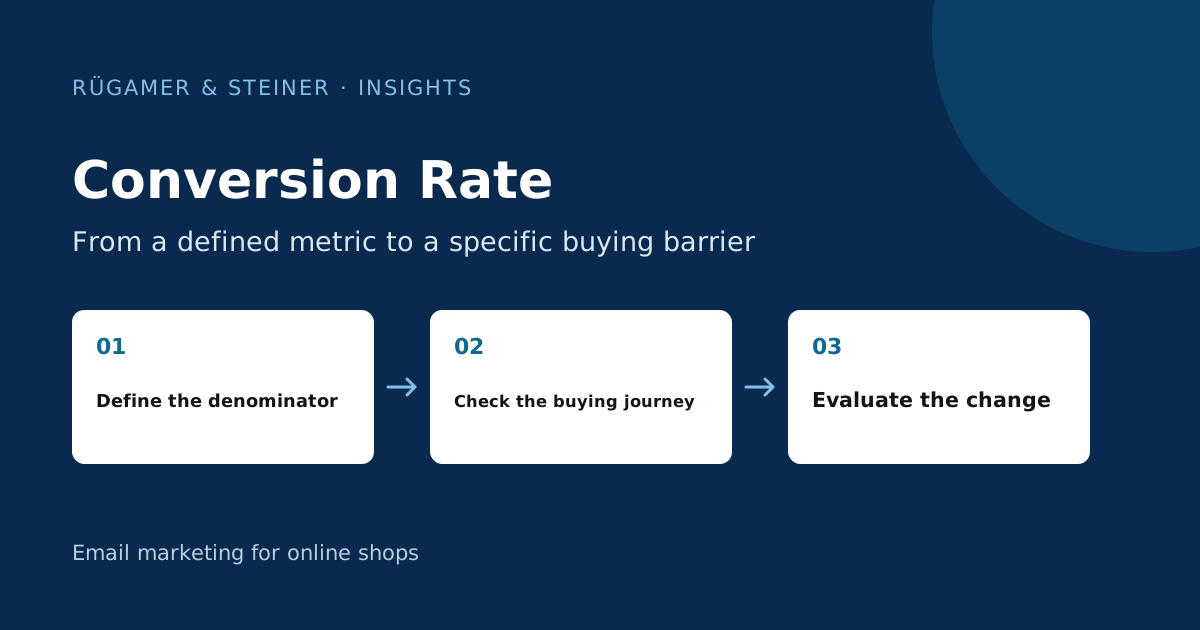
Identify the event and denominator for each metric: unique clickers per email delivered, clickers per opener, or purchases per tracked shop session are different metrics. Then check data quality and specific barriers to purchase. Evaluate changes against a predefined performance metric, alongside costs and errors.
Which conversion rate are you referring to?
A conversion rate is the proportion of a defined reference quantity that achieves a specified target action. In a shop, this might be one order per measured session; on a landing page, one sign-up per measured visit. Specify whether you are counting sessions, users, recipients or events. A customer may generate multiple sessions and multiple orders; these quantities are not interchangeable.
Email terms also require a precise definition. The Klaviyo glossary for analytics distinguishes between the click rate based on delivered recipients and the click-through rate based on openers. In other reports, CTR is used differently. You should therefore state the denominator rather than relying solely on the abbreviation. Open data may also be influenced by email programmes.
Three illustrative calculations using fictional figures
A hypothetical newsletter example has 10,000 recipients to whom it was delivered and 400 unique clickers. The click rate, calculated from delivered emails, is four per cent. With 2,000 recorded opens, the same number of clicks results in a click-through rate of 20 per cent, using recorded opens as the denominator here. These are different metrics for the same example message. The second result does not automatically make the first email five times more successful.
A separate fictional shop example has 350 tracked sessions from a tagged campaign entry and 14 sessions resulting in a purchase. The session-based purchase rate is also four per cent. It answers a different question to the email click-through rate. For the purposes of this calculation, assume that purchases are correctly attributed to sessions and that no order events are recorded twice. Do not indiscriminately mix the tool figures from different identity models.
Check events and counts first
Use a test order of your own to check whether the product view, shopping basket, checkout and purchase appear in the intended report. Google’s Documentation on e-commerce measurement describes corresponding events and parameters. A single order page may generate multiple events after being reloaded. Use reliable transaction identifiers and synchronise orders with the shop system.
Make a note of which sessions are captured by your actual measurement and which data is missing. Consent, device changes, aborted payment redirects and differing domain settings can complicate the context. UTM parameters identify a visit, but do not in themselves prove any additional impact of the newsletter. Leave this uncertainty in the report. A seemingly particularly precise percentage is of no help if the denominator is incomplete or inconsistent.
Check promises and landing pages together
Open every important newsletter link on a smartphone. Anyone clicking on a specific jacket should find the correct jacket with available variants. Compare the image, price, promotional terms and language between the email and the landing page. A link to the general homepage requires a new search and may lose the context. A product that is now sold out needs a clear alternative or a clear indication of this.
Check the first visible information: delivery availability, size guide, relevant material details and price components. Which of these are important depends on the product range. Fill in missing information in a targeted manner, rather than filling the page with general reassurances. Document the issue you have identified as a specific observation, for example: ‘The size chart cannot be opened in the mobile layout.’ This statement is verifiable and leads to a clear correction.
Go through the checkout process using real test cases
Test guest checkout and the available payment methods in the designated test mode. Check address entry, delivery options, error messages, abandoned baskets and the mobile keyboard. A form should provide a clear explanation of an invalid postcode and retain fields that have already been filled in correctly. Also check whether navigating back from the payment provider clears the selection or inadvertently triggers a second order.
Carry out the test with more than one product and compare variants, quantities and the total amount. A code provided in the newsletter must work under the conditions that actually apply. Record any failed steps, noting the expected and observed behaviour. The most significant improvement may be the resolution of a reproducible error. This does not require a randomised experiment to confirm that the error has been rectified.
Which change is worth an A/B test?
An A/B test may be useful for testing a content hypothesis, such as a more precise selection guide before checkout. Define in advance the variant, the primary success metric, the allocation and the planned duration. In addition to purchases, check returns, discount costs and technical errors. A clearer product promise must not create false expectations that only become apparent after delivery.
Test one coherent idea where possible, and keep other campaigns clearly documented. Small samples and few purchases cannot establish a reliable winner. Klaviyo’s Campaign statistical significance guide is a product-specific guide; it is not a universal approval for every shop test. An inconclusive result may mean that the change shows no discernible improvement under the observed conditions.
From the result to the next review
- Clearly state the reporting period, target action and denominator.
- Check the email address, landing page and checkout individually.
- Reconcile transaction data with the shop and identify any obvious double counts.
- Evaluate mobile and desktop results only where the data is comparable.
- Record price, stock levels, promotions and customer demographics as contextual information.
- After making a correction, run through the original error case again.
Assess the economic contribution alongside the conversion rate. A shop may generate more orders whilst, at the same time, contributing less due to deeper discounts. Prioritise the next observed hurdle accordingly. This creates a transparent improvement process that considers marketing content and actual purchasing behaviour together.
Sources and further documentation
Product documentation and primary sources relating to the steps described. Editorial source date: 5 October 2026.