At a glance
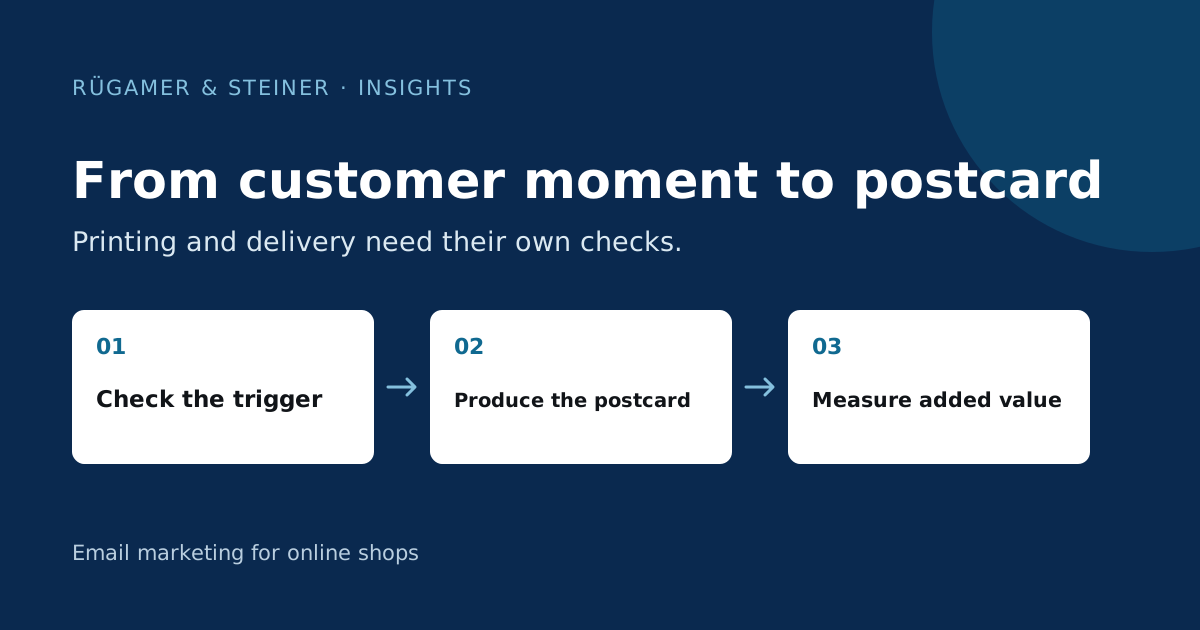
Print mailings are physically delivered advertising materials such as postcards or letters. Programmatic Print combines a defined customer touchpoint with automated production. For a meaningful test, you need suitable addresses, exclusions, a clear message and a randomly selected control group. QR scans or vouchers alone do not prove additional revenue.
What is the purpose of the print mailing?
Start with a situation that could be made clearer or more eye-catching through a physical message: a collection for long-standing customers, a seasonal reminder or an invitation to a specific service. A broad recap of the last newsletter does not in itself provide a justification. Contrast the idea with a simple question: What decision does this card make easier for this person?
A specific example is a shop selling high-quality coffee grinders. Customers who have purchased an older grinder receive an invitation to a maintenance service with a brief explanation of the process. The card links to an appointment form and an estimated price range. Any discount promotion for new grinders would provide a different context. Before starting the design, set out the target audience, benefits, landing page and timeframe in a briefing.
What does ‘Programmatic Print’ mean with Klaviyo?
The term describes an automated process for routing customer data or events to print production. It does not make paper immediately deliverable, nor does it enable native email delivery. Klaviyo explains in its Guide to direct mail integrations how a print platform exchanges data: audiences or flow triggers are passed to the platform, and production and response events can be sent back.
Check the actual process with your chosen provider rather than relying on a logo in the integration directory. What data is transferred? When can an order still be cancelled? How are duplicate triggers prevented? What happens if a house number is missing or a purchase is made shortly before printing? Document the final check before handover. Once production has started, a subsequent purchase may no longer be able to stop the card that has already been printed.
Check addresses and exclusions before sending to print
A valid email address is not the same as a valid postal address. Check the name, street, house number, postcode and country; test special characters, business addresses and address suffixes. Avoid sending duplicate cards to the same household, unless your campaign specifically requires it. An out-of-date delivery address may accurately reflect a previous order but may still be unsuitable for a current mailing.
Define exclusions for current buyers, outstanding complaints and documented objections. Consent to the use of data for postal purposes must be clarified for this purpose. A missing email opt-in does not, in itself, constitute authorisation for another channel. The Klaviyo Academy demonstration of a direct mail flow indicates a specific supplier route; its address matching and delivery terms are not a general guarantee for all integrations or countries.
Designing a postcard with a clear reading order
The opening should state the context, image and the key benefit. This is followed by a brief explanation, terms and conditions, and a clear next step. Leave sufficient space for the address and postal specifications. The actual dimensions, bleed and print resolution will be provided by the contracted print supplier. A screen preview does not replace a full-size printout.
Only personalise using reliable data. A relevant product category is often more helpful than an uncertain first name. For missing details, each line of text requires a complete standard version. A short QR link and a written-out alternative make it easier to navigate to the shop. Open both on a smartphone and check that the campaign page, language and advertised offer are correct. A personalised code should not appear as a readable customer record in a public URL.
Which costs should be included in the comparison?
Take into account design, data preparation, printing, postage, processing, software and, where applicable, address verification. Added to this are the discount actually redeemed and the operational costs of the offer. A unit price that excludes these components underestimates the effort involved. Before the test, enquire about minimum quantities, country-specific prices, misaddressed items and possible repeat orders. Price quotations for a single offer cannot be applied across the board to subsequent productions.
In addition to revenue, consider the contribution margin based on the variable costs relevant to your shop. A high-value shopping basket with a low margin may contribute less than a smaller service order. Set a limited budget and a clear decision threshold for the initial test. The number of printed cards or scanned codes is a process metric; it does not yet indicate whether the campaign is economically viable.
How does a holdout test reveal additional impact?
Randomly split a suitable target group in advance. One group receives the card, the other does not. Both groups receive the same other campaigns. Define the measurement period and purchase definition before dispatch. Record orders from the entire respective group, even if buyers do not scan a QR code. Otherwise, you will mainly be measuring the selected response channel.
Fictitious calculation example: Out of every 1,000 people, 45 order with a card and 30 without a card. The observed difference is 15 orders. Assuming a contribution margin of 35 euros per additional order, this amounts to 525 euros. If the 1,000 cards cost 600 euros including postage, the difference is minus 75 euros before any further fixed costs. These figures are a model; they do not represent actual R&S customer results. Minor differences may be random and require appropriate analysis.
What do you check before sending your first actual email campaign?
- An authorised test address receives exactly one card with correct details.
- Excluded purchasers and people who have opted out do not enter production.
- The absence of personalisation results in a standard text.
- The QR code and short URL lead to the relevant mobile offering.
- Print orders, production status and feedback are traceable.
- The control group, measurement window and costs are defined before sending.
Start by defining a clearly delimited objective. First, review data and delivery; then examine responses and compare these with the control group. An additional channel is only useful if its own contribution justifies the extra effort. The existing email flow should remain comprehensible and reliable throughout the test.
Sources and further documentation
Product documentation and primary sources relating to the steps described. Editorial source date: 5 October 2026.