At a glance
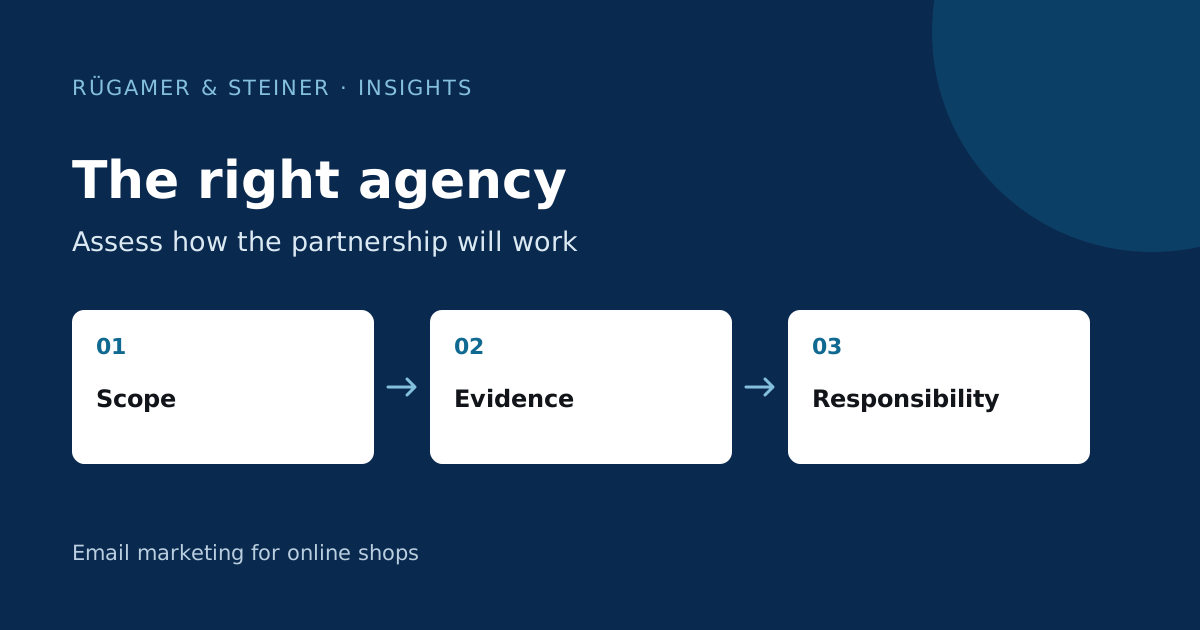
Use the briefing below for all providers. Ask for details of the outcome, the work required on your part and who is responsible for each service. Then compare complete design examples and an annotated report before weighing up the scope and price against one another.
A briefing you can use straight away
Copy these points into your enquiry. Where information is missing, write ‘to be clarified’. This is more helpful than estimated figures without a basis. Summarised details are sufficient for an initial assessment; login details or lists of personal recipients should not be included in the enquiry.
Briefing for our email marketing
- Shop and product range: URL, key product categories, B2B/B2C, countries and languages.
- Systems: Shop system, email platform, other relevant interfaces.
- Current setup: Current mailing frequency, number of contacts eligible for marketing as at the reference date, existing flows.
- Problem: Which tasks remain outstanding? Please provide a specific example, such as missing product descriptions or unchecked automations.
- Objective of the first phase: What should be delivered or work reliably at the end of the phase?
- Our contribution: Available images, product information, internal contacts and time required for approvals.
- What we want the agency to handle: Strategy, copy, design, technical set-up, sending or analysis — select the tasks you need.
- Framework: Desired start date, budget and foreseeable campaigns or product launches.
A specific first-phase objective could be: “Document our three existing flows, check for duplicate messages and resolve the priority issues.” Your current setup determines whether three flows or a different scope makes sense. The guide to email flows helps to describe these tasks in more detail.
Make the scope of services comparable
Separate one-off set-up from ongoing support. Ask the agency to walk you through a typical newsletter, from the first content idea to the send. At each stage, establish who creates, checks and approves the work.
| Section | Specific question | Useful references |
|---|---|---|
| Planning | Who develops the topics if we only provide product data? | An example content plan specifying the audience, campaign occasion and materials required. |
| Text & Design | Are concept development and proofreading included? | Complete draft; specify the number and scope of revisions. |
| Technology | Which existing flows are being reviewed and, where necessary, amended? | List of affected processes, verification criteria and documented changes. |
| Evaluation | What happens after a notable result? | Report including interpretation, next steps and responsibilities. |
| Sending | Who checks recipients, links, prices and dates? | A named approver and a documented test before sending. |
Also check whether new automations, the revision of existing emails and ongoing campaigns are calculated separately. Quantity specifications should be clear: do variants, revision cycles or different languages each count as a separate email? The clearer the offer, the easier it is to assess the actual scope.
Put examples and client testimonials in context
Ask to be shown a complete draft and have two decisions explained: why does this content appear at the beginning, and why does the main link lead to this destination? The annotated Normrahmen design concept shows how to assess a layout in this way. More design examples from our work are available in the gallery. An image export shows the design; technical quality also requires a test email.
Customer testimonials provide further insights into the collaboration. When dealing with sales figures, enquire about the baseline, time period, measurement criteria and any concurrent promotions. In the Sabro case study you can read about newsletters, a VIP sale and reduced day-to-day work. The interview with Seaside64 also explores newsletter quality and a lighter workload for the team. These are individual experiences, rather than predictions for your store.
Check platform knowledge and measurement logic
If you use Klaviyo, ask the agency to explain how it manages triggers, profile filters and overlaps between messages. A helpful question to ask is: “What happens to a customer who abandons their checkout but then makes a purchase before receiving the next email?” The official documentation on flow filters provides a basis for the conversation.
Reporting should be clear. Ask whether attribution-window changes are documented and how revenue, discounts, unsubscribes and list growth are assessed together. The agency should be able to explain differences between Klaviyo and GA4 reports. Our guide to email marketing metrics puts these measurement questions in context.
You should also ask who, specifically, will be working on your account as part of the collaboration. A partner directory can help with your research; to make your selection, you will also need answers to the questions set out in your briefing.
Clarify responsibilities and the start phase
- Access: What authorisations are required, who manages them and who remains responsible for the account?
- Material: Who provides product information, images, offers and current availability details?
- Approvals: Who approves the copy, prices and send? How much time is allowed for feedback?
- Quality: What tests are carried out before launch, and how are errors or queries handled?
- Handover: How are templates, flow logic and previous results documented?
Before choosing, test the proposal with one question: could your team tell what should have been delivered after the first month? If the answer is only “ongoing optimisation”, ask for the scope and deliverables. Then consider the agency fee, platform costs and remaining in-house workload together.
Sources and further documentation
Product documentation and primary sources relating to the steps described. Editorial source date: 10 September 2026.